Anzio
I Heard You Paint HousesAnzio was the coastal town north of the German line at Monte Cassino and south of Rome where the Allies opened a second front against German forces in Italy. For Frank Sheeran and the 45th Infantry Division, the landing offered a chance to turn the stalled fighting at Monte Cassino into a breakthrough. Instead, the beachhead became a place of prolonged confinement: a surprise arrival gave way to four months of bombardment, dug-in defense, and waiting.
Strategic Setting and the Landing
The move to Anzio followed more than two months of fighting near Monte Cassino. The 45th Infantry Division had been committed to repeated, costly attacks against German positions in the mountains. A monastery above the line served as an observation post; when it was eventually bombed, the rubble gave German troops additional protection. General Mark Clark described the division as having spent seventy-two days in continuous combat under extreme conditions, including bitter cold, wet weather, and almost constant artillery and mortar fire. Pulling the division back from that front, the Allies aimed to land behind the German line and attack its flank, giving the main force a better chance to break through.
After a brief rest near Naples, in a former Italian royal palace, the troops boarded landing craft for Anzio. The landing caught the Germans by surprise, and the Allies took a couple of hundred prisoners. The first day ashore was quiet as the troops moved inland from the beach. But the commander in charge feared that the apparent opening was a trap and decided to wait for tanks and artillery to arrive before advancing. That pause changed the character of the operation. It gave the Germans time to bring their own tanks and artillery into position above the beachhead, dig in, and make it difficult for Allied equipment to land.
The Beachhead Under Fire
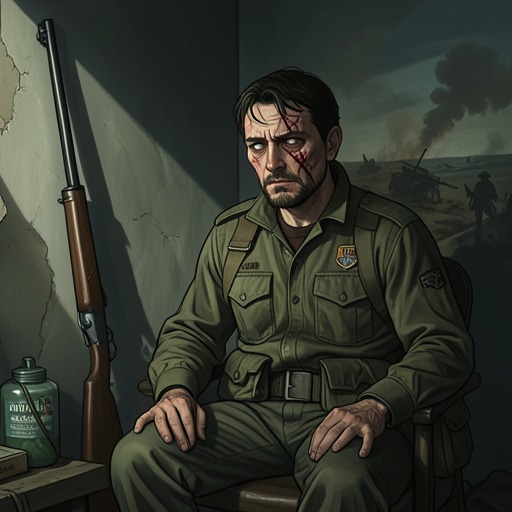
German artillery and aircraft soon attacked the exposed Allied positions. Ordinary foxholes were not deep enough to offer adequate protection, so soldiers dug shelters about eight feet down. They climbed in and out on foot ladders and covered the openings with boards and tree branches, which helped keep out rain and absorb shrapnel. The shelters were both a response to the relentless bombardment and a boundary around daily life: during daylight, leaving one could expose a soldier to German fire.
The troops remained under attack for four solid months. German aircraft bombed supply ships, preventing the delivery of cooked food; soldiers ate canned K-rations instead. They played cards, talked about what they hoped to do after the war, and prayed. Sheeran recalled that soldiers who might not otherwise have prayed did so under the pressure of the siege, making promises to change their lives if they survived. The account places this religious appeal alongside the most physical details of the beachhead: the deep dugouts, the ration cans, and the danger of emerging into daylight.
Night brought a distinctive threat. The Germans concealed a large artillery piece during the day, then brought it into position on a railroad track outside Rome after dark, when Allied aircraft were on the ground. The troops called it the Anzio Express. Its incoming shell sounded like a boxcar passing overhead, a noise that made each barrage frightening even before its destination was known. Soldiers could not know which nearby group would be hit, or whether the next shell would land on them. They took turns serving as sentries about a hundred yards out on the perimeter, while conventional shelling continued through the day. The night gun and the daytime bombardment turned the beachhead into a test of endurance as much as a contest for territory.
Holding the Line
The Germans twice advanced against the Allied position in an effort to drive the troops off the beach. The 45th Infantry Division helped repel the attacks, and the Combat Report described its defense as tearing apart the attempt to erase the beachhead. But holding the ground did not bring an immediate advance. The fighting settled into what the report characterized as long months of holding and waiting, with constant bombardment and more than 6,000 Allied lives lost during the period.
Anzio’s strategic purpose therefore remained suspended for months. The Allies had landed north of the German line, but the delay after the initial success allowed German forces to contain them. The beachhead endured, yet its troops could not simply move forward: daylight movement was dangerous, supply ships were under attack, and German forces held positions above them. In Sheeran’s recollection, the siege is registered through the repeated constraints on ordinary action—where a soldier could go, when he could leave shelter, what he could eat, and whether he could sleep.
Relief and the Road to Rome
In May, the main Allied force broke through the German line at Monte Cassino. By the end of the month, about 150,000 exhausted but relieved soldiers emerged from their Anzio dugouts and linked up with the force advancing from the south toward Rome. The beachhead had finally served as part of a renewed advance, though only after months in which its troops had been pinned down. On June 6, the Allied landing in Normandy opened another front in Europe, placing the prolonged Italian campaign within a wider Allied offensive.
The troops later entered Rome without a fight. For Sheeran, the change from siege to city life was marked by sidewalk cafés, lunch, and wine—a sharp contrast with months of canned food and shelter. Anzio thus occupies two connected places in his account: first, the dugout-bound beachhead where survival narrowed to protection and endurance; then, a stage in the advance that brought the soldiers out of the siege and into Rome.